

A peloton is the main pack of riders in a road race: the tight group of wheels, helmets and jerseys that moves along the road as one block. David Gerstein, an Israeli artist, has made that pack the subject of several 3D metal wall sculptures.
This guide covers four pieces of peloton art from his studio. For each one you will find what the main product photo shows and the size, layers, edition and technique listed on its product page, then a comparison table and notes on which kind of wall each size fits.
What a peloton is, and why Gerstein shows it
In road cycling, riders stay close together so that most of them ride sheltered from the wind behind the riders in front. That is why a peloton looks like one dense shape rather than a line of separate cyclists.
Gerstein explains his interest on the product pages for the two Peloton Wave pieces. He writes that he has "always been fascinated with birds that fly in a 'V' shape" and that cyclists "have figured out how to create a similar energy-saving formation with the arrangement of a peloton." Riding so closely together, he adds, "reduces drag significantly."
The studio's about page explains that his 3D work started with cut-outs in cardboard and wood, then aluminum and steel, with each cut-out painted and then overlapping in space. Each of the four sculptures below is listed with three or four layers.
Peloton Wave Big A: a pack rising to the right

Peloton Wave Big A by David Gerstein
The main photo of Peloton Wave Big A shows a side view of a pack of riders packed wheel to wheel, all heading to the left. The group sits low on the left and climbs toward the upper right, where the last rider is the highest figure in the piece. Jerseys, helmets and even the wheels are broken into short horizontal strokes of red, orange, blue, green, yellow and purple.
Its product page lists 156 x 75 cm / 61 x 30 in, 3 layers, edition 150 and year 2008.
Peloton Wave Big B: the same idea as an arch

Peloton Wave Big B by David Gerstein
Peloton Wave Big B carries the same text from Gerstein about birds and the peloton, but the composition is different. Again the riders are seen from the side, heading left. The pack rises toward the middle and then drops away on the right, where the last two riders sit lower and are tilted, so the whole outline reads as an arch. The colours lean more toward red and orange, with blue, green and yellow mixed in.
Its product page lists 163 x 78 cm / 64 x 31 in, 3 layers, edition 150 and year 2008, so it is 7 cm wider and 3 cm taller than Big A.
Tour de France Frontal-New: the pack coming toward you

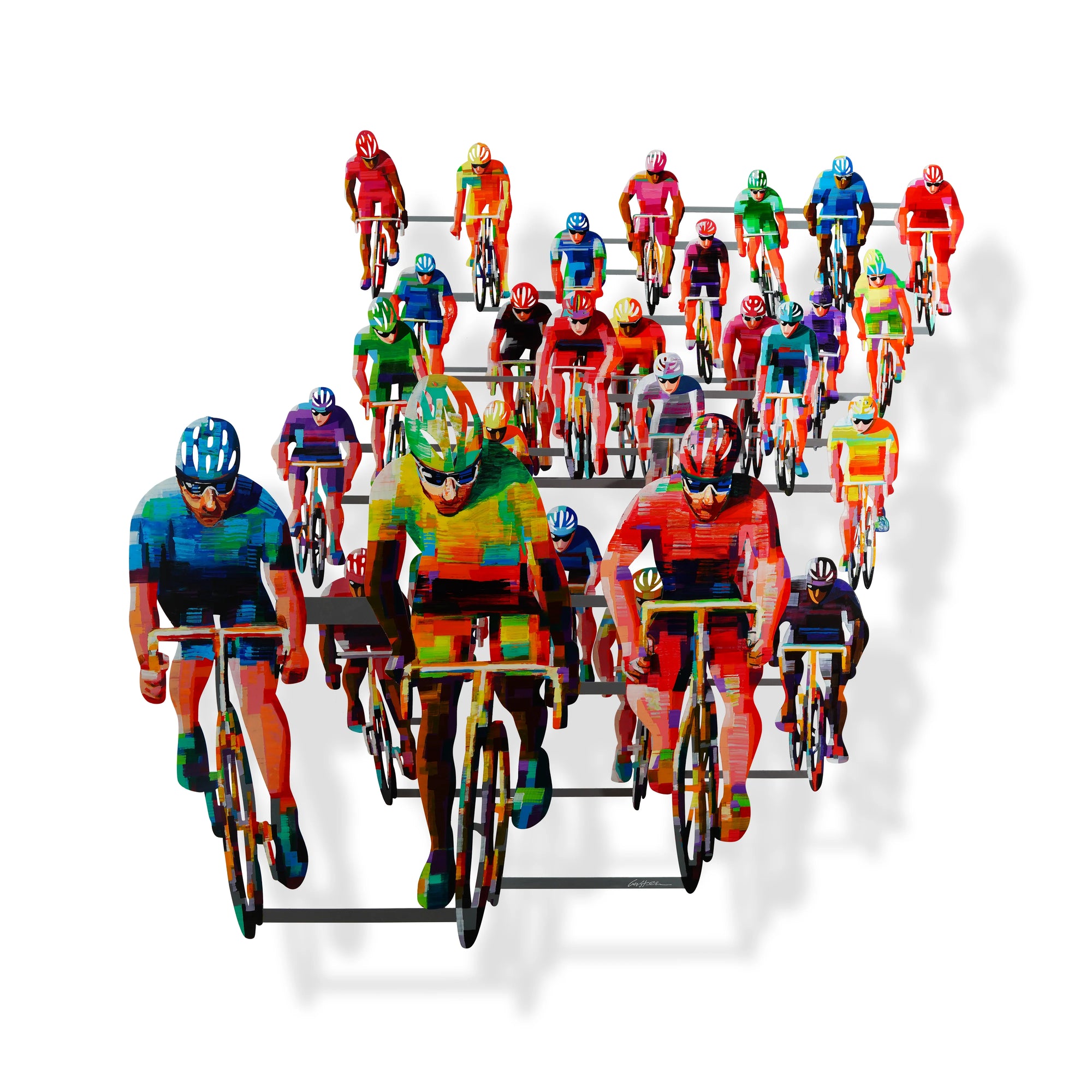
Tour de France Frontal-New by David Gerstein
Its product page does not use the word peloton, but the main photo of Tour de France Frontal-New shows a large pack of riders seen head-on, riding toward the viewer. Three large riders in blue, yellow-green and red jerseys lead at the front. The riders behind them get smaller toward the top of the piece, which gives a strong sense of depth, and thin dark bars link the figures together. On the page Gerstein writes: "When painting these men in a cycling competition, I see them as one."
Its product page lists 155 x 160 cm / 61 x 63 in, 3 layers, edition 150 and year 2015.
Tour de France Vertical-New: a tall column of riders

Tour de France Vertical-New by David Gerstein
Tour de France Vertical-New uses the same head-on view in a tall, narrow format. One large rider in a yellow and orange jersey leads at the bottom left, and many smaller riders stack up behind him toward the top. Gerstein writes on the page that "for three consecutive weeks these men cycle on their tour", and that he does not paint them as individuals: "they become one expression of connectedness with each other and their audience around the globe."
Its product page lists 71 x 180 cm / 28 x 71 in, 4 layers (the only one of the four with more than 3), edition 150 and year 2015.
Comparison at a glance
Artwork |
Size |
Layers |
Edition
|
Peloton Wave Big A |
156 x 75 cm / 61 x 30 in |
3 |
150 |
Peloton Wave Big B |
163 x 78 cm / 64 x 31 in |
3 |
150 |
Tour de France Frontal-New |
155 x 160 cm / 61 x 63 in |
3 |
150 |
Tour de France Vertical-New |
71 x 180 cm / 28 x 71 in |
4 |
150 |
All four product pages describe each piece as an original signed edition by David Gerstein, with a certificate of authenticity.
Choosing between them
The two Peloton Wave pieces are each about twice as wide as they are tall. That shape suits a long, low wall, such as the space above a sofa, a sideboard or a bed. Big B is the larger of the two.
Tour de France Frontal-New is close to square and covers the most wall of the four, at 155 x 160 cm. It needs a large open wall with clear space around it, such as an entrance hall, a stairwell or a wide living room wall.
Tour de France Vertical-New is the tallest at 180 cm but only 71 cm wide. It fits a narrow wall: between two windows or doors, at the end of a corridor or beside a staircase.
Whichever you prefer, measure the wall before you choose. To compare these with his other work, browse the full collection of 3D Metal Wall Sculptures by David Gerstein.
FAQ
What does peloton mean?
Peloton is the cycling term for the main pack of riders in a road race. Riders stay close together to save energy. As Gerstein puts it on the Peloton Wave product pages, riding so closely together "reduces drag significantly."
Where can I see more of David Gerstein's cycling art?
For a wider look at his cycling works, read David Gerstein Bicycle Series 3D Wall Art for Your Home.
How do I ask about availability?
Contact the studio with the name of the piece you are interested in.